
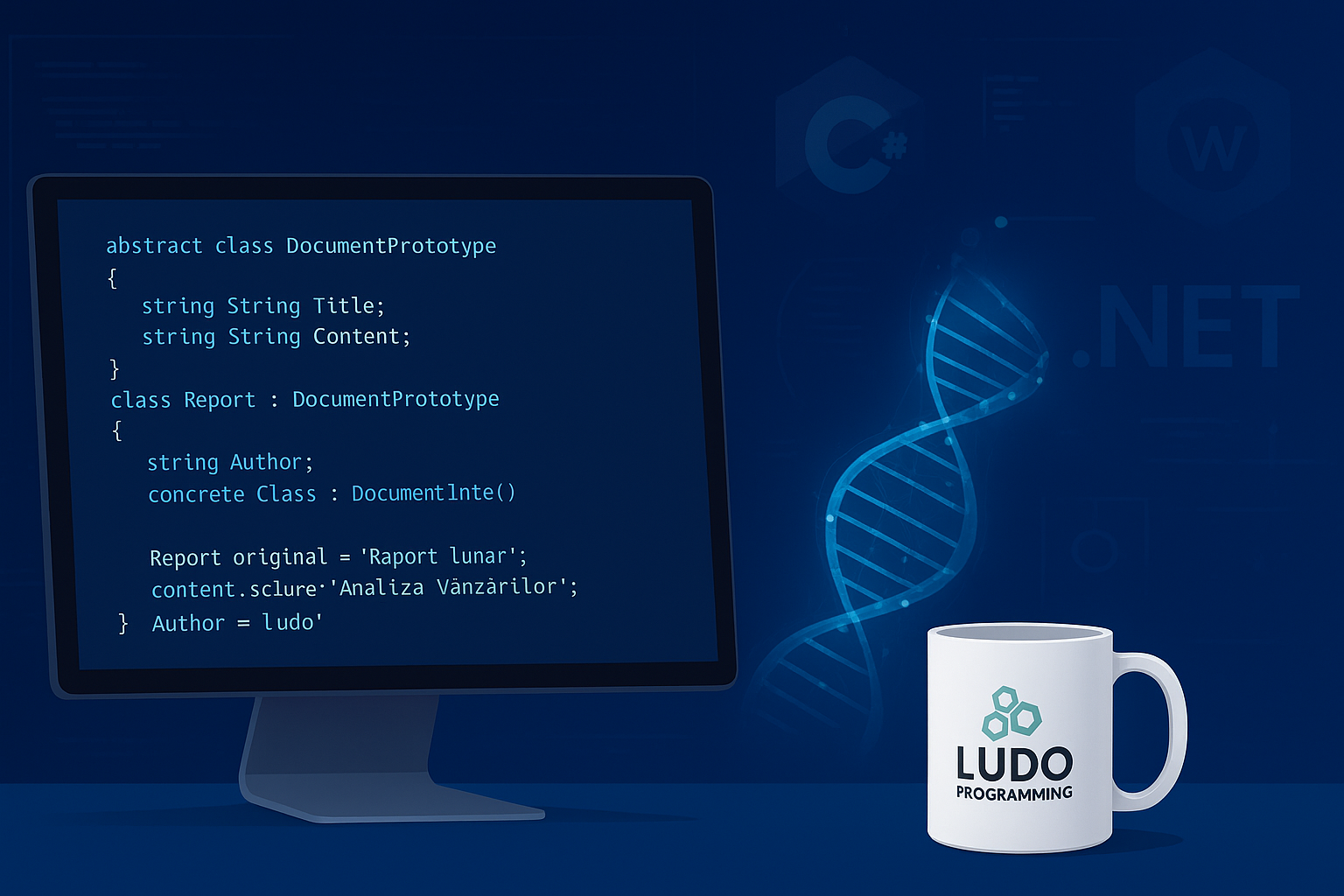
In modern .NET architectures, reuse and flexibility are essential. Prototype Pattern is one of the creational design patterns, used to create new objects by cloning existing instances, without depending on concrete implementation details.
It is ideal when the process of creating objects is costly or complex, and cloning an existing instance is more efficient and cleaner.
🔍 What is Prototype Pattern?
The main purpose of this pattern is copying an existing object (called prototype) to generate new ones, preserving the same attributes and behaviors.
Instead of calling new and building from scratch, we create an already configured copy — an elegant approach, especially in enterprise .NET applications with complex entities, configurable objects, or recurring data models.
🧩 General structure
The pattern involves:
-
Prototype (interface) – defines the Clone() method, used to create a copy of the object.
-
ConcretePrototype – implements the Clone() method and defines how the object is copied.
-
Client – uses the Clone() method to generate new instances without knowing the exact class.
💻 Practical example in C#
public abstract class DocumentPrototype
{
public string Title { get; set; }
public string Content { get; set; }
public abstract DocumentPrototype Clone();
}
public class Report : DocumentPrototype
{
public string Author { get; set; }
public override DocumentPrototype Clone()
{
return (DocumentPrototype)this.MemberwiseClone();
}
}
// Usage
var original = new Report
{
Title = "Monthly Report",
Content = "Sales analysis",
Author = "Ludo"
};
var copy = (Report)original.Clone();
copy.Author = "Another author";
Console.WriteLine($"Original: {original.Author}");
Console.WriteLine($"Copy: {copy.Author}");
📘 In the example above, MemberwiseClone() creates a shallow copy, sufficient for simple objects.
For more complex structures (e.g., lists, nested objects), a deep copy can be implemented manually or using serialization.
🧠 Advantages
✅ Better performance – avoids full reconstruction of costly objects.
✅ Flexibility – allows creating variations of the same type without modifying the base class.
✅ Isolation from concrete details – client code does not depend on specific types.
✅ Simplifies configuration process – you can start from a predefined prototype (e.g., settings, templates).
⚠️ Disadvantages
❌ Can be complicated for composite objects with multiple references (deep copy needed).
❌ Requires attention to mutable references – a clone sharing data can cause unwanted side effects.
❌ Can be confusing if the system has too many prototype types.
🏗️ When to use Prototype Pattern?
-
When creating an object is costly (e.g., reading from large files, complex configurations).
-
When you need to create many similar objects, but with small variations.
-
When the system must be independent of the concrete classes that define the objects.
Real example: in a billing system, you can clone a standard invoice template and just modify the customer data.
Or in a design application, you can clone a graphic shape and adjust the color or size.
🧩 Prototype in the .NET context
.NET offers direct support through the MemberwiseClone() method, but for more advanced scenarios you can use:
-
Serialization-based cloning (via System.Text.Json or BinaryFormatter)
-
Copy constructors for full control over the process
-
Record types (in C# 9+) – provide with expressions for elegant immutable copying
public record Product(string Name, decimal Price);
var original = new Product("Laptop", 5999);
var copy = original with { Price = 5799 };
This example shows a modern and safe variant of the prototype concept, natively integrated into the language.
🚀 Conclusion
Prototype Pattern is an elegant solution for situations where you want to quickly create similar objects without recreating all the initialization logic.
In .NET, it naturally blends with modern paradigms (record types, clone methods, object templates) and brings a boost in performance and clarity to the code.
🔧 “No need to reinvent the object – clone it smartly!”