When you hear the word “automation,” you probably think of something complex, expensive, and requiring a programmer. In reality, in 2026 there are dozens of tools that allow you to automate repetitive processes in your business without writing a single line of code and without paying thousands of euros.
This article is not about enterprise automations or complex technical integrations. It’s about simple, practical things you can implement this week — and that really make a difference.
What automation means, in plain language
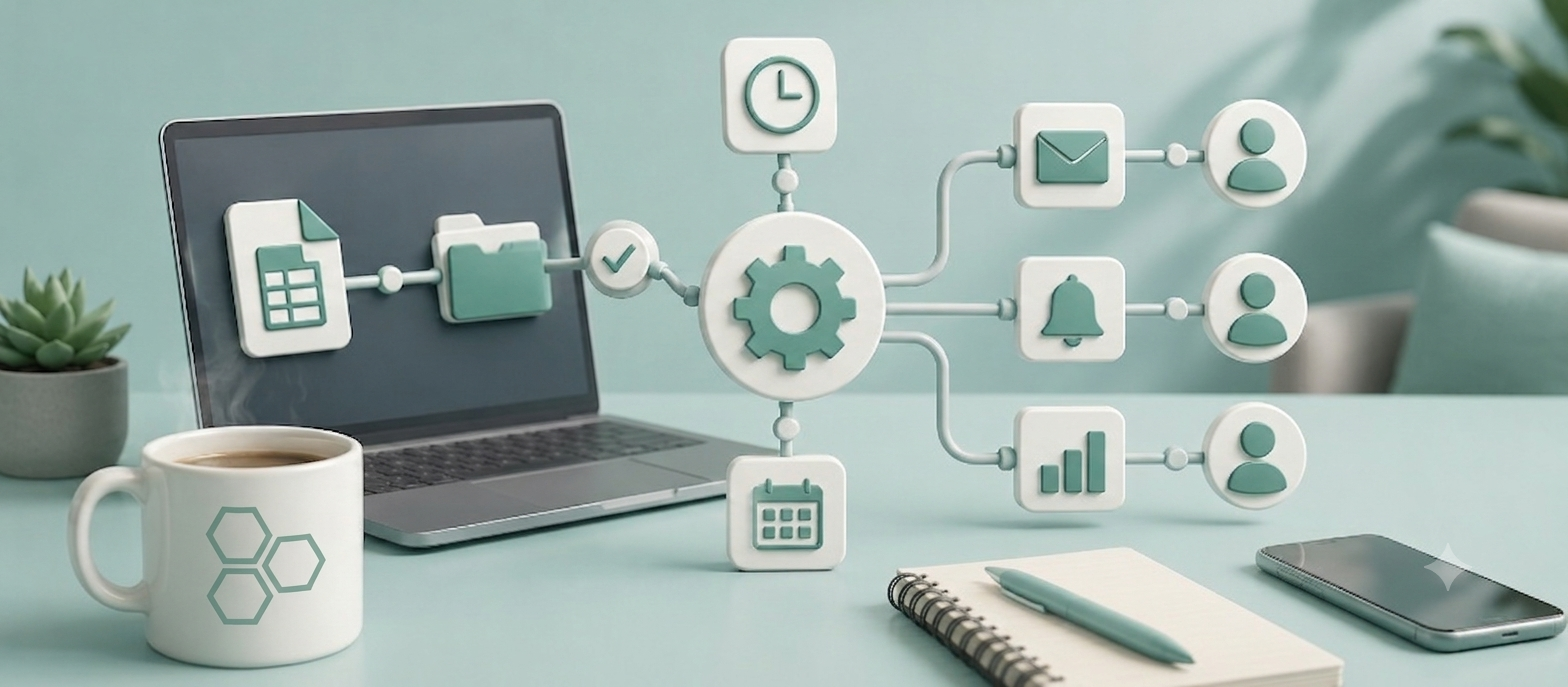
An automation is any action that happens automatically, triggered by an event, without you having to do something manually every time.
Simple examples: when someone fills out the contact form on your website, they automatically receive a confirmation email. When a customer hasn’t purchased in 90 days, they automatically receive a reactivation email. When you post an article on your blog, it automatically appears on your Facebook page.
These are not magic. They are simple rules like “if X happens, do Y” — which you set once and let work.
Email automations that save time and bring money
Welcome email — sent automatically immediately after someone subscribes to the newsletter or creates an account. It’s the most opened email you will ever send — the open rate is 3–5 times higher than average. Use it to introduce yourself, explain what they will receive, and offer something useful right away.
Onboarding series — 2–3 emails sent automatically in the first 7–14 days after subscription or first purchase. The goal is to guide the new customer to understand the value of what they received or bought. A customer who understands what they bought is a returning customer.
Abandoned cart email — if you sell online, this is probably the most valuable automation you can set. When someone adds products to the cart and doesn’t complete the order, they automatically receive an email 1–2 hours later. The recovery rate is between 5–15% of abandoned orders — money that would otherwise be completely lost.
Reactivation email — sent automatically to subscribers or customers who haven’t interacted with you for 60–90 days. Simple and direct: “We missed you. Are we still relevant?” with a good reason to come back. Cleans the list of inactive contacts and recovers some of them.
Review email — sent automatically 3–7 days after delivering a service or product, with a direct link to the Google reviews page. You automate exactly what we know works but no one has time to do manually for each client.
Automations for social media
Scheduling posts — instead of posting in real time, you prepare your content weekly or monthly and schedule it. Meta Business Suite (free) does this for Facebook and Instagram. Buffer or Later are popular alternatives with free plans.
Republishing evergreen content — good blog articles don’t have to be posted just once. Tools like MeetEdgar or Publer allow you to create a content library that reschedules automatically at intervals you set.
Automatic replies on Messenger — Meta Business Suite lets you set an automatic welcome message and an automatic reply outside business hours. Small detail, big impact — the client knows the message arrived and that you will respond.
Automations for customer relationship
Automatic appointment reminders — if you have a business based on appointments (salon, medical office, consultancy, service), an automatic reminder sent 24 hours in advance dramatically reduces no-shows. Acuity Scheduling, Calendly, or even Google Calendar can do this for free.
Automatic follow-up after a meeting — if you use a simple CRM like HubSpot (free), you can set an automatic email sent 48 hours after a meeting recorded in the system. “It was a pleasure to talk — here is the promised offer / answers to your questions.”
Internal notifications — when a client fills out a form, when a payment is confirmed, or when a deadline approaches, you can automatically receive a notification by email or phone without manually checking each platform.
Simple tools you can start with
Make (formerly Integromat) — connects apps with each other without code. Example: when you receive an email with a new order, automatically add the client to a Google Sheet and send a notification on WhatsApp. Free plan available.
Zapier — similar to Make, easier to use for beginners, slightly more expensive on paid plans. Over 6,000 apps available for connection.
Mailchimp / Brevo / MailerLite — all three include email automations in free plans: welcome emails, onboarding series, behavior-based emails.
Meta Business Suite — free, scheduling posts for Facebook and Instagram, automatic Messenger replies, statistics.
Calendly — automatic appointments with reminders included. The client chooses the available time slot themselves, you receive confirmation and reminder. Free plan sufficient to start.
Where to start if you are at zero
Don’t try to automate everything at once. Start with a single automation that solves a real and repetitive problem in your daily activity.
The best starting point for most small businesses: welcome email and social media post scheduling. Both can be set up in under an hour, are free, and bring immediate value.
Once you see how it works, add one by one. You don’t build a complex system from scratch — you build a thin layer of automation over what you already do.
Conclusion
Automations don’t replace your relationship with the customer. They free up time so you can build it better.
Every hour you gain from automated processes is an hour you can invest in things that really require your presence: a conversation with an important client, a personalized offer, a strategic decision.
The tools exist, are accessible, and are simpler than you think. The only real obstacle is to start.