
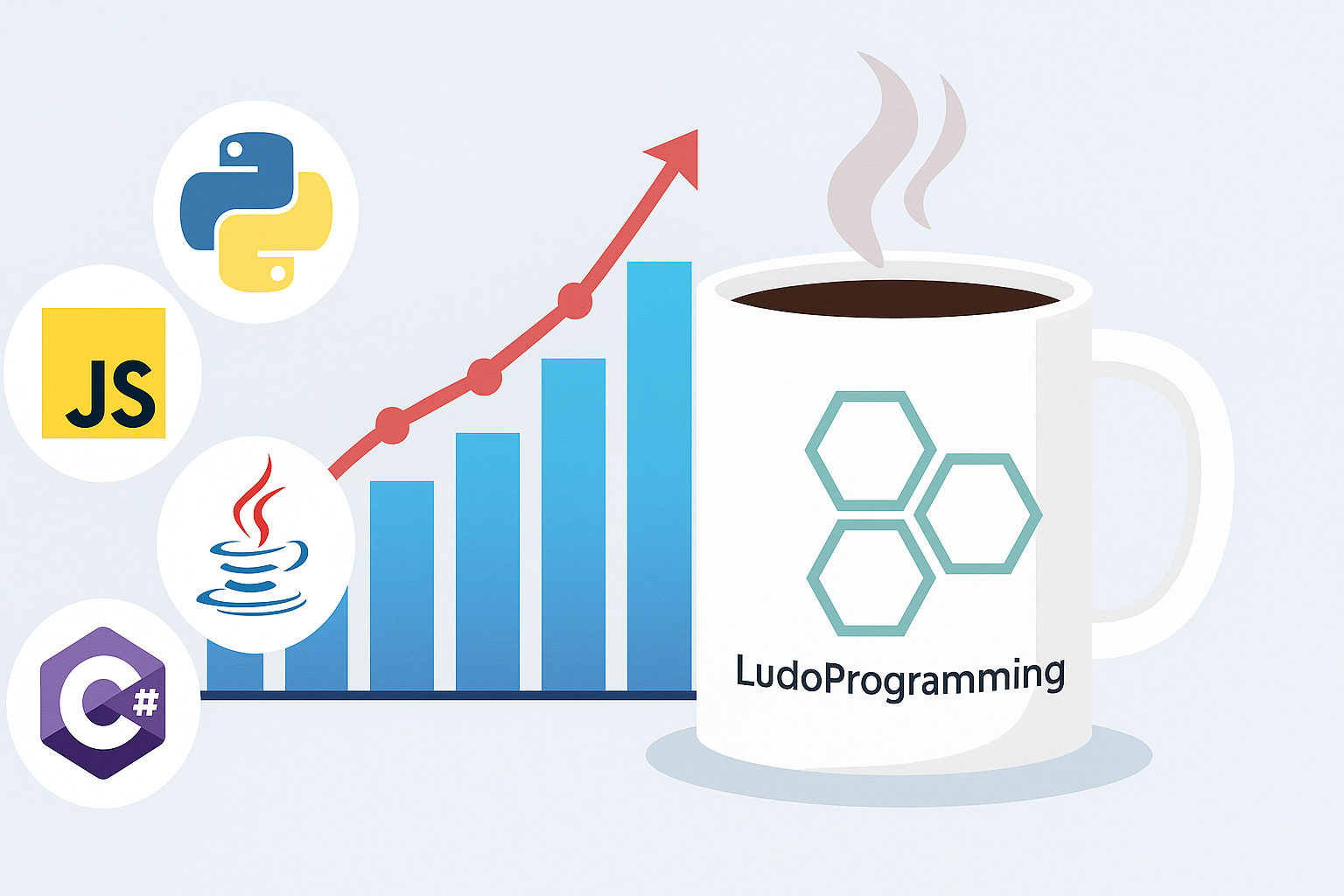
The TIOBE ranking for October 2025 brings some interesting surprises in the top programming languages. Although Python consolidates its supremacy, the return of the C language to the top 2, the spectacular rise of Perl, and the stability of C# define the current landscape of the software industry.
📊 Complete data can be consulted here: TIOBE Index – October 2025.
🥇 Python: undisputed leader of the decade
Python is once again in first place, with an impressive share of 24.45%, marking an increase of +2.55% compared to last year.
The reason for its success is clear: versatility. From machine learning (TensorFlow, PyTorch) to web development (Django, FastAPI) and automation, Python continues to be the preferred language of researchers, students, and independent developers.
Moreover, the massive adoption of AI tools based on Python strengthens this position for the coming years.
🥈 C returns to the podium
After a period of decline, the C language rises from 4th to 2nd place, reaching 9.29%.
The explanation is twofold:
-
the growing interest in embedded systems and IoT, where C remains the de facto standard;
-
the proliferation of low-level projects for AI accelerators, microcontrollers, and kernels.
Although it is an old language, C once again demonstrates that efficiency and memory control remain irreplaceable values.
🥉 C++ and Java lose ground
C++ drops from 11.61% to 8.84%, losing 2nd place, while Java falls from 3rd to 4th, at 8.35%.
Both languages face fierce competition from new generations: Rust, Go, and C#.
Although C++ continues to be essential for high-performance applications (3D engines, financial systems, databases), its complexity remains an obstacle for new programmers.
In contrast, Java loses ground to the Kotlin + Spring Boot ecosystem, which offers a more modern syntax and better support for cloud-native applications.
💪 C#: steady growth and full maturity
C# remains in 5th place, but with solid growth (+1.32%), reaching 6.94%.
The .NET 8 ecosystem and the success of Blazor, MAUI, and ASP.NET Core keep the language relevant for modern development, whether we talk about web, desktop, or cross-platform applications.
More and more developers choose C# for its clear syntax, excellent integration with Azure, and support offered by the community and Microsoft.
🧩 JavaScript and Visual Basic – stability without growth
JavaScript remains in the top 10 with 3.41%, but without major changes. Although it dominates the front-end, the emergence of WebAssembly-based frameworks (including Blazor and Rust WASM) has slightly reduced interest.
Surprisingly, Visual Basic maintains its 7th position, with 3.22%, thanks to persistent use in enterprise and legacy applications.
🐫 Perl and R rise spectacularly
The biggest surprise of the month is Perl, which climbs from 29th to 12th place, with a +1.10% increase.
The reason? Its renewed popularity in scripting and Linux infrastructure administration, especially in DevOps automation.
Also, the R language (used for statistical analysis and data science) rises to 13th place, indicating that the data science field remains an important driver of the industry.
⚙️ Rust, Go, and Kotlin – stagnation or transition?
Languages considered "of the future" seem to have entered a phase of maturation without growth:
-
Go remains in 8th place, with a slight decrease (-0.10%), mainly used for microservices;
-
Rust slightly decreases to 1.19%, indicating that although loved by enthusiasts, enterprise adoption is slower;
-
Kotlin remains stable at 0.98%, thanks to the Android and Spring Boot ecosystems.
🔮 Conclusion: diversity, not dominance
The October 2025 ranking clearly shows that there is no single "winning" language, but rather a mature and diversified ecosystem.
Python remains the undisputed leader, but C, C#, Go, and Rust demonstrate that each niche has its own champion.
The balance between performance, productivity, and portability defines the future of programming – and 2025 confirms that developers choose the right tools, not the most popular ones.
Want to explore more data or the complete history?
📈 Consult the official source: https://www.tiobe.com/tiobe-index/