
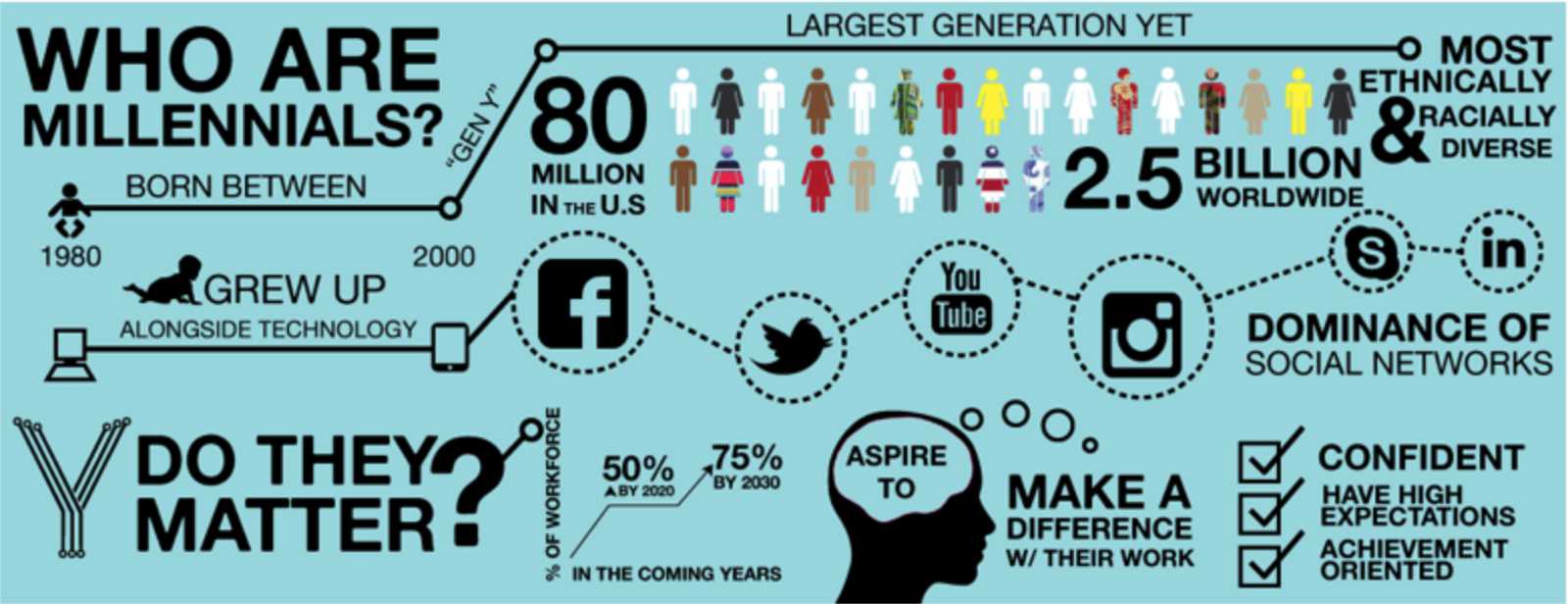
Millennials is a term that has appeared relatively recently here, even though across the ocean it has been used since the 1990s. But what does this term mean and why should those of us working in online and business be interested in this term and especially what does it represent?
Millennials represent a target audience, an increasingly important market for B2C businesses, that is, those businesses that address the final consumer directly and need to sell something to them. Also known as Generation Y, the young people who make up this category were born somewhere between 1982 and 2000, following Generation X, the Generation in jeans. In other words, this group includes young people between 16 and 33 years old, young people who are now at the beginning of their lives and who differ, through the environment and lifestyle in which they were raised, from the previous generation. Precisely because they developed and formed in a completely different environment, these young people have a different conception of life, different needs, different preferences, different criteria on which they base their decisions.
But how do you approach this audience so that your content is successful?
1. Authenticity. The new generation spends a lot of time online, looking for what is authentic, that is, what fits very well with what they believe, think, with the principles and causes they support. They are always looking for a voice they can identify with.
2. Inbound. Traditional methods of attracting traffic to a site or redirecting traffic from one site to another are completely disliked by the new generation. A study conducted by Wired says that millennials have effectively killed many such methods simply by leaving sites that bombard them with invasive, valueless, or simply annoying ads. This phenomenon also happens because young people know what they want and what they are looking for, and technology is their ally. When they are online, they search for information on Social Media, blogs, various websites, YouTube, everywhere. That is why it is easy for them to immediately give up on a site that is too invasive with ads or that does not offer them the peace and space they need.
3. Inform. Generation Y young people want to be informed and will always be attracted to those who offer quality information. They are interested in e-books, videos, tutorials, how-tos, blog articles, anything that can contain as much information as possible about the subject or subjects that interest them. As mentioned about the niche, it is very good and advisable for companies to correctly identify the niche they address and to provide as much information as possible, well organized.
Some studies show that millennials are much (247%) more likely than older people to be influenced in their purchasing decision process by social networks or blogs. If what you offer in terms of content can be easily shared on Social Media, then you have even more to gain.
4. Personalization. Beyond the fact that they are up to date with everything new and fashionable, with technology, and generally have access to quite generous funds, young people are also very smart or, rather, have a different way of thinking than those over 40. In other words, we don’t have to sell them a product, but rather a lifestyle. Show them what our product offers, what benefits they have if they use it, how to use it, and what special experiences they will have through it. The technical features of the product or service are no longer as important as the experience offered.
5. Involvement. Yes, their involvement in the creation process. This trend is increasingly observed here as well, but it is quite timid. Young people like to be involved, asked, to participate in the creative part, in decision-making, in product testing. They want to be heard and for their opinion to be taken into account.
6. Use versus purchase. Young people – less so here, more abroad – have started to increasingly change their consumption habits. In other words, they now prefer to rent a certain item rather than buy it and have it at home forever. An example is Uber, but in the USA, for example, there are also sites that rent clothes. When it comes to content, this trend should be translated into things, eBooks, or courses that can be rented and not necessarily bought.
7. A complete experience. Millennials love, for example, the shopping experience itself, not just purchasing a product. This is proven by the searches they make, as well as by the success of, for example, Pinterest. For what you publish to be successful in this context, it must be as connected as possible to these networks, to this style of distributing, searching, saving, and being as useful and as to the point as possible.
8. Mobile optimization. Generation Y is practically glued to their mobile phone or tablet, and most of their searches happen on mobile. Therefore, the site, as well as the content, must be optimized so that it can be read or opened from any type of device. This generally refers to the chosen images, which must be visible both in the normal (vertical) position of the phone, as well as videos.
9. Video. Starting in 2014, videos on Facebook have become a habit, and young people already consider them much more credible than anything that can be broadcast on TV. The popularity of videos on the internet is growing, so adapting to this type of content is essential to keep young people engaged. People and characters who are popular on YouTube are more credible than TV personalities, so preferences and the concept of celebrity have begun to change.
The conclusion is that those who manage to keep up with millennials and adapt to their preferences and pace of life will be successful and will be winners in the world of online marketing.