
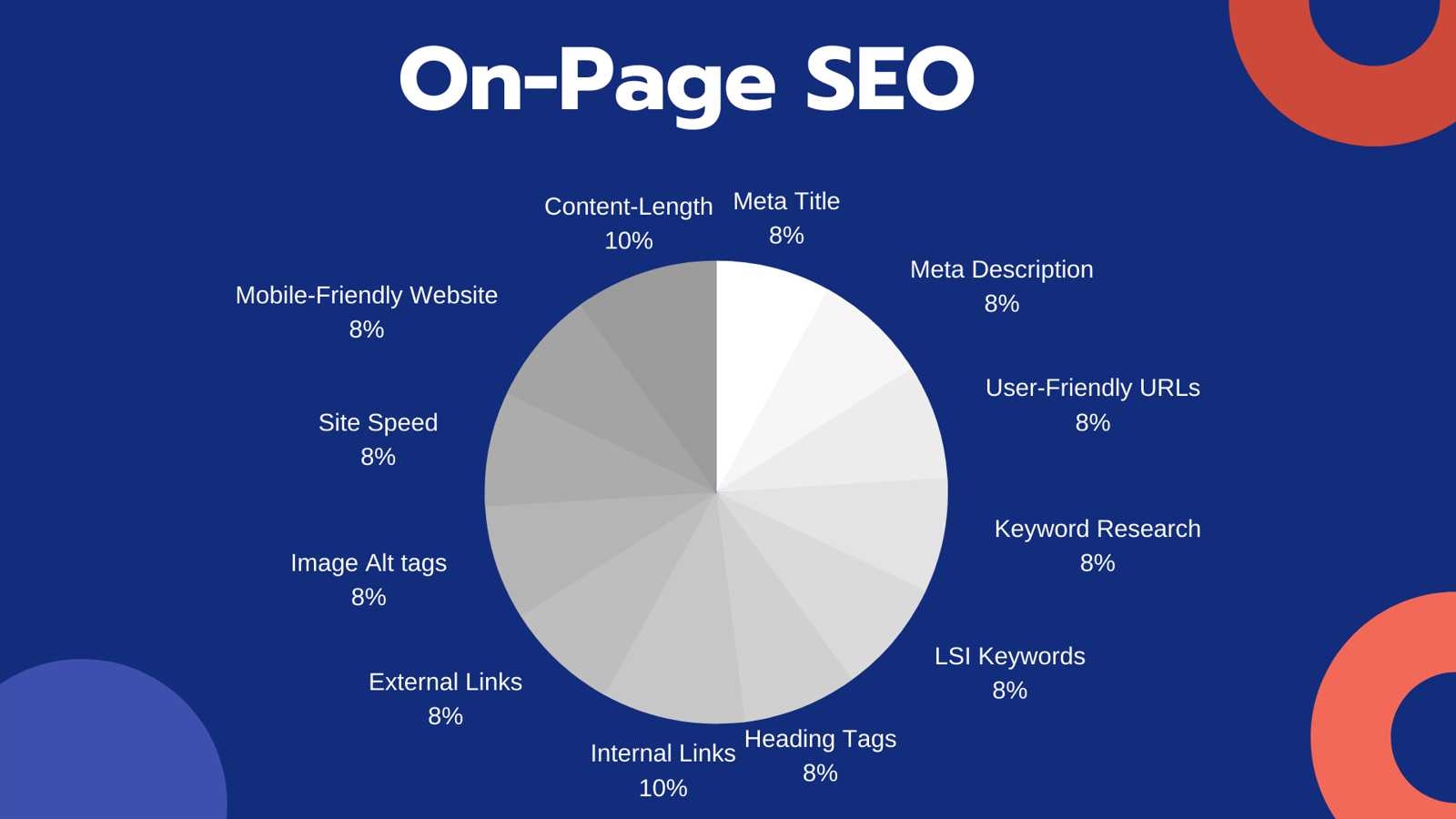
The content of a page is created for people who come to read and get informed. However, search engines cannot interpret the text the way humans do. That is why a little help from us, the marketers, is needed. Search engines must be given a series of clues about the subject of that page. These clues provide the page's relevance, allowing search engines to display it as a result following searches for the most appropriate keywords. Understanding the best techniques for achieving relevance greatly helps in positioning the page as high as possible.
We start by presenting the simplest techniques, and then we will deal with the more complex ones. However, the best advice is to test them all – maybe even others in addition – and use those that seem to work best for you.
1. Keywords. Although we said that on-page SEO is not limited to keywords only, the truth is that it starts here. They will always remain the basic element, and their use will be maintained in the essential points. Keywords must be used in four key places: in the Title, in the URL, in the body of the text, and in the ALT attribute of the images used. Of course, not all variants and all words can be used, but the central element, the main keyword, must be chosen carefully. On the other hand, it should be considered that aggressive use of keywords can be considered spam.
2. TF-IDF – term frequency-inverse document frequency. This technique does not refer to measuring the frequency of the keyword, but to its importance compared to the frequency of the keyword in a set of documents. In other words, the rarer the chosen keyword is used, the better its score will be. Common words like "and, but, or, of, not, only" have a very low score because they are very frequently used. On the other hand, "carboxylic acids" is a phrase – a much rarer keyword. If this phrase appears on a site, there is a higher chance that the respective page is about organic chemistry than others.
3. Synonyms and related words. Google, as a result of over 6 billion daily searches on its search engine, has concluded that it is best to include synonyms and related words in the elements considered to display the best results, especially since synonyms are decisive in about 70% of searches. Because sometimes there can be a misinterpretation of the meaning in which a word is used, Google also analyzes the other words on the page to see what the term is associated with and to classify it correctly. For example, the term "limestone" can bring to mind the stone extracted from quarries, but it can also be used by dentists for dental conditions.
4. Page segmentation. In other words, the position of words on the page is important, not just meeting the other points on our list. Although it has always been better for keywords to appear in the central part of pages, since the shift to mobile internet usage, this positioning has become even more important. In other words, it is most advisable for our keywords to appear in the Header and Main body text. On mobile, the tendency is to hide the sides of the pages, so only these two elements appear.
5. Distance. Even if the content is okay from the point of view of page segmentation, the position within the segment must also be considered. Words in the same sentence or the same paragraph will be much better associated in terms of relevance than if they were physically separated by several paragraphs. Google calculates the physical distance between keywords, between words with variants and synonyms, to see the actual connection between them.
6. Context or phrases. Until now, we have talked about isolated keywords, whether simple words or phrases, and about their position and distance between them. But in the indexing process, Google introduced a new technique, namely one related to the context in which a certain keyword is found or used. The principle is quite simple and starts from the idea that a word does not appear in isolation but in the broader context of a subject. In other words, if you want to talk about a mushroom pasta recipe, you will surely also use words like "salt, spoon, oil, pasta, heat, minutes, water." If you want to talk about mushroom cultivation, you will use a completely different vocabulary: soil, humidity, temperature, ground, planting, harvesting, growth time, watering, etc.
For this purpose, the links used also help a lot, which must come from pages with the same subject.
Certainly, these are not the only methods or techniques used by search engines to correctly index pages and to provide the best and most conclusive results following users' searches. However, they certainly help to a considerable extent. Some of these techniques have been contested by some, but over time they have proven their usefulness.
If you liked the article, you might also be interested in:
- 5 tips for creating attractive content for your website or
- The blog – from personal journal to online business