
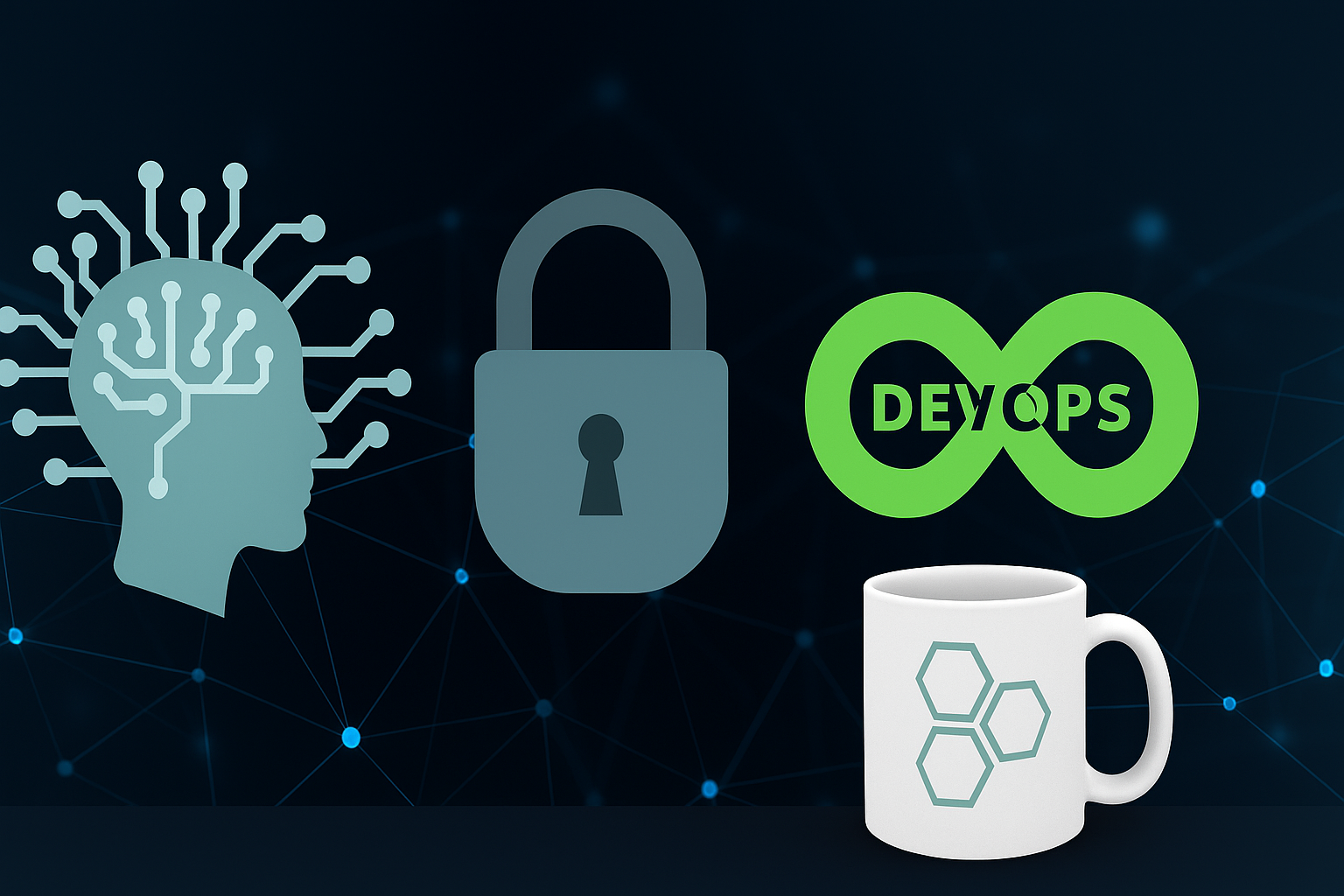
If digital infrastructure was the foundation on which technological progress was built, artificial intelligence, DevOps culture, and cybersecurity have been the engine that brought modern IT to its current level. The last two decades have completely transformed the way we develop software, how we test it, how we deliver it, and how we protect it.
🤖 The Rise of Artificial Intelligence
What at the beginning of the 2000s seemed like a distant promise – machines capable of learning on their own – became reality in just a few years. Artificial Intelligence (AI) has evolved from simple classification algorithms to deep neural networks (Deep Learning), capable of recognizing images, voices, or complex patterns from huge volumes of data.
Progress was accelerated by GPU processing power, the immense volume of data available online, and the emergence of open-source frameworks such as TensorFlow and PyTorch. Today, AI is no longer just a research field but an omnipresent tool:
-
filters spam from emails,
-
automatically translates texts,
-
recognizes faces and objects in images,
-
optimizes marketing campaigns and logistics flows,
-
generates content (text, code, images) with the help of GPT models.
AI has thus become the core of a new technological era – one in which systems not only execute instructions but think and anticipate.
⚙️ DevOps – the bridge between development and operations
Another major revolution of the 21st century in IT was the emergence of the DevOps culture. Before 2010, developers and infrastructure administrators worked separately: some wrote code, others kept it alive. With the increasing complexity of applications and the need for rapid deliveries, DevOps was born – a model of continuous collaboration between development (Dev) and operations (Ops).
DevOps completely changed the workflow:
-
Continuous Integration / Continuous Deployment (CI/CD) became the standard for fast and stable releases;
-
Test and infrastructure automation reduced delivery time from months to hours;
-
Real-time monitoring of applications allows proactive error detection.
Tools such as Docker, Kubernetes, GitHub Actions, Jenkins, or Terraform have put the power of automated infrastructure at the disposal of any developer. The result? More agile teams, more stable applications, and an accelerated innovation cycle.
🛡️ Cybersecurity – the challenge of the digital century
As the digital world has grown, so have the threats. In the last two decades, cybersecurity has become a critical field, with the explosion of phishing, ransomware, and DDoS attacks.
Organizations can no longer treat security as a secondary stage – it must be integrated from the design phase. The concept of “Security by Design” and the practices of DevSecOps have emerged precisely to unify development, operations, and security into a continuous process.
Modern technologies include:
-
multifactor authentication (MFA) and zero-trust architecture,
-
advanced encryption for data in transit and at rest,
-
AI-based detection for threats and anomalies,
-
cloud protection and automated vulnerability management.
Security is no longer just an IT responsibility but a pillar of global digital trust.
🌐 The convergence of AI, DevOps, and security
Currently, these three fields naturally intertwine. AI is used to detect security breaches, DevOps accelerates patch integration, and cybersecurity ensures system resilience.
Companies that adopt an integrated ecosystem – AI-driven DevSecOps – are those that can innovate quickly without compromising safety.
This convergence has completely redefined how companies think about software infrastructure: from a set of disparate processes into an intelligent, automated, and secure organism.
🔍 Conclusion
From machine learning algorithms to CI/CD pipelines and zero-trust protections, the last two decades have created a new DNA for the IT industry. Artificial intelligence brought the power of prediction, DevOps offered speed and agility, and security ensured stability and trust.
Together, these three directions define 21st-century software innovation.