
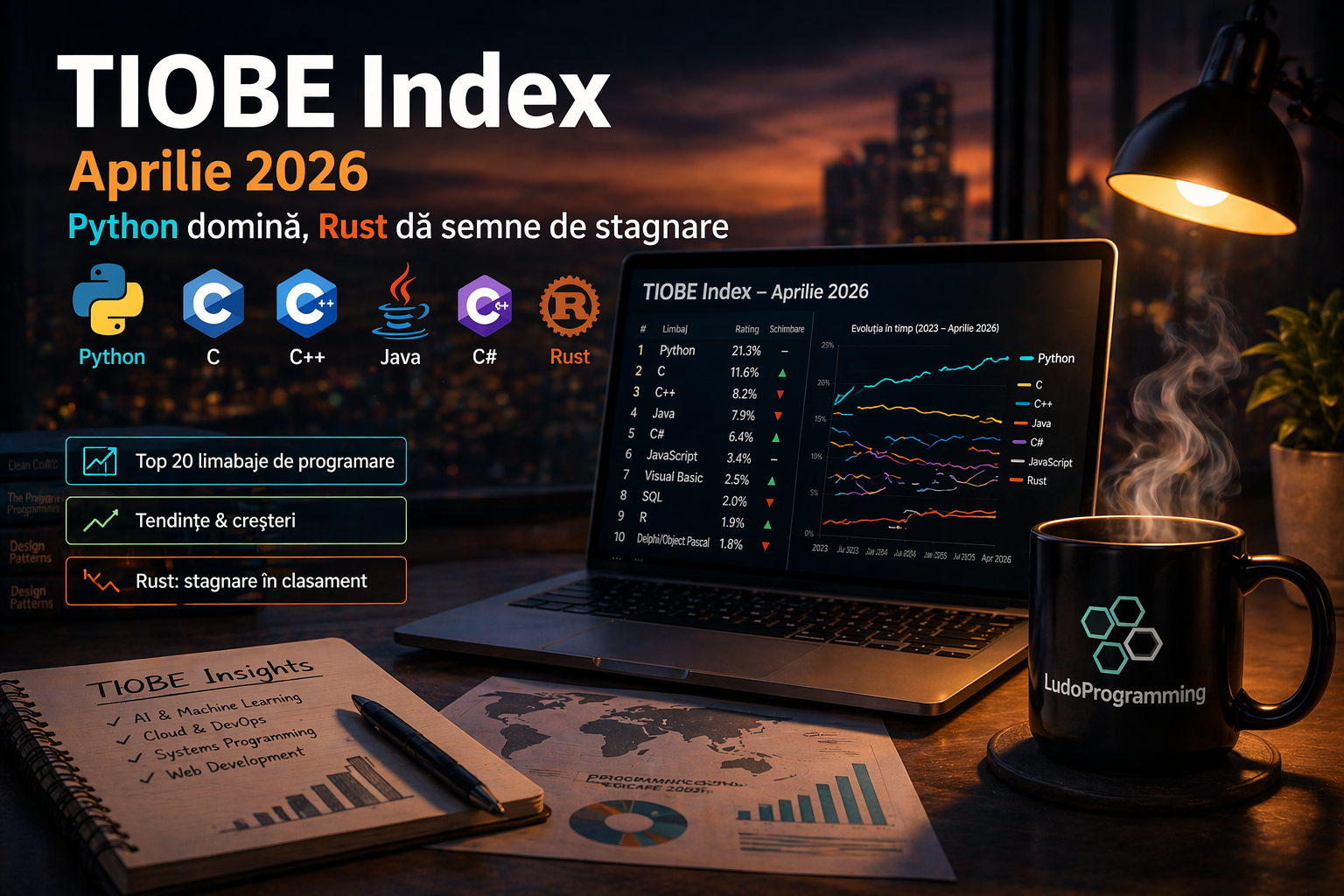
The TIOBE Index is one of the most closely watched barometers of programming language popularity worldwide. Calculated monthly based on data from major search engines — Google, Amazon, Wikipedia, Bing, and others — the index does not necessarily reflect the quality of a language, but the active interest of the community in it: the number of engineers, available courses, and third-party providers.
The April 2026 edition brings some significant movements compared to the same period last year. Here is what the numbers tell us.
Python remains the leader but loses rating
With a rating of 20.97%, Python continues to hold first place — a position it has held uninterrupted for several years. However, the decrease of -2.11% compared to April 2025 shows that its dominance, although solid, is no longer growing. The context is clear: the market is saturated with Python for AI/ML, and developers are exploring more performant alternatives.
C rises to 2nd place, surpassing C++
One of the notable moves this month is C, which climbs from 3rd to 2nd place, with a rating of 12.34% (+2.39%). C++ correspondingly drops from 2nd to 3rd, with 8.03% (-2.30%). This reversal reflects the steady interest in embedded programming and low-level systems, where C remains the reference language.
C# growing — a good sign for the .NET ecosystem
In 5th place, C# records one of the biggest increases in the top 10: +1.59%, reaching 5.98%. The growth can be correlated with the increased adoption of the .NET platform for cloud-native applications, recent developments in .NET 9 and .NET 10, as well as interest in game development through Unity.
Go — dramatic fall from 7th to 15th place
Go records the largest drop in the top 20: -1.92% and a fall of 8 positions, from 7th place (April 2025) to 15th place (April 2026). This is a surprising development for a language actively supported by Google, with a solid ecosystem for microservices and DevOps tooling. It is possible that Rust and TypeScript have cannibalized some of the attention that was going to Go.
Rust: the rise has slowed down
The editorial headline of TIOBE this month is about Rust. Although the language entered the top 20 in June 2020 and reached its best-ever placement (13th place) at the beginning of 2026, in just three months it dropped back to 16th place. The current rating is 1.09% (+0.13%).
TIOBE's explanation is clear: Rust is extremely powerful in areas where performance and memory safety are critical, but the learning curve remains steep for non-expert programmers. Broad, mainstream adoption seems difficult, and a spot in the top 10 now seems more distant than it did a year ago.
Positive surprises: R, Perl, Swift
Several languages deserve mention for their upward trends:
- R climbs from 14th to 9th place (+0.43%) — a sign that statistics and academic data science remain growing fields.
- Perl makes a spectacular leap: from 19th to 12th place (+0.57%) — an unexpected comeback for a language considered by many "vintage".
- Swift rises from 26th to 19th place (+0.24%) — the Apple ecosystem remains attractive to mobile developers.
Historical perspective: who has stood the test of time?
The TIOBE historical table is always revealing. C has held 1st place from 1986 until today — a durability record hard to match. Python rose from 27th place in 2001 to 1st place in 2026. Java, the former king of the rankings (1st place from 2006 to 2016), is now in 4th place.
These long-term trends show that a language's popularity is closely tied to the ecosystem around it — frameworks, tooling, job market demand — not just intrinsic technical qualities.
Conclusion
The TIOBE Index of April 2026 confirms a period of consolidation in the programming language landscape. Python remains the undisputed leader, C makes a strong comeback in the top 2, and C# continues to gain ground in the enterprise ecosystem. On the other hand, Go and Rust — two languages with much enthusiasm around them — show that online popularity does not automatically translate into sustained adoption.
If you are a developer planning your next learning investment, this month's TIOBE data suggest that Python, C#, and R are safe medium-term choices.