
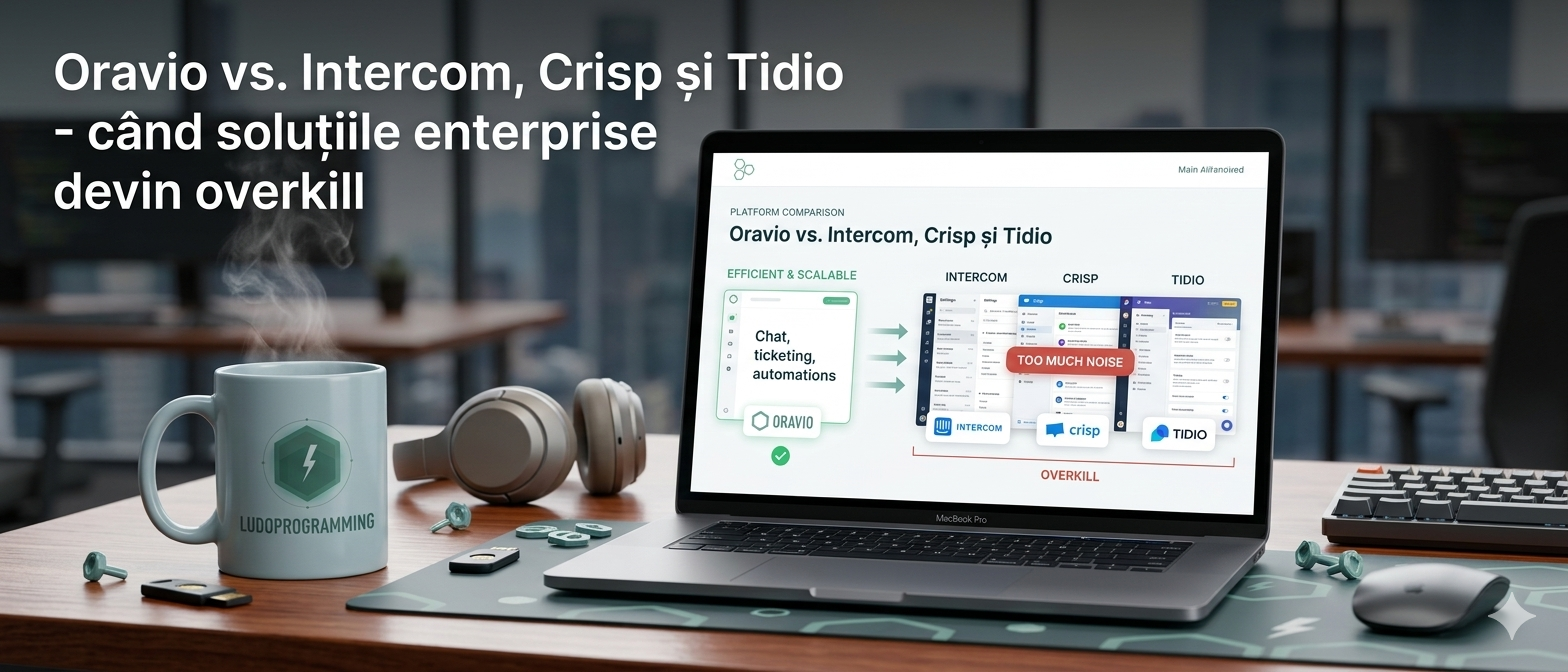
If you have ever looked for an AI chatbot for your website, you have probably come across the same trio: Intercom, Crisp, Tidio.
Large platforms, with teams of dozens of people behind them, impressive functionalities, and inevitably, prices to match.
The question few ask themselves before signing a subscription:
“Do I really need all this?”
This article is not an attack on enterprise solutions — they are good tools, built for real problems. It is more of an exercise in honesty: what you pay for, what you get, and when it makes sense to choose something else.
💬 What enterprise solutions offer
Intercom is probably the most well-known name in the industry. The entry plan costs $29/seat/month, but that’s just the beginning. If you want Fin AI — their artificial intelligence agent — to resolve conversations autonomously, you pay an additional $0.99 per resolved conversation. Add an Analytics plan and a Copilot add-on and you quickly reach hundreds of dollars per month, for a single company, with a single product.
Crisp starts with a free plan with 2 seats, but the Mini plan that brings real functionalities costs $45/month per workspace, and Essentials with omnichannel support goes up to $95/month. If you want white-label and advanced automations, you’re at $295/month.
Tidio has a more accessible structure — Starter at $24/month, Growth from $49/month — but the AI agent (Lyro) is separate, from $32.50/month extra, with a limited number of conversations included.
All three have something in common: they are built around support teams. They have shared inboxes, automatic ticket assignment, performance reports per agent, CRM integrations, SLAs. They are customer support operations platforms, not simple chat widgets.
⚠️ Where the problem arises
Imagine you have a technical blog with a few hundred readers per month. Or a presentation site for a freelancer. Or documentation for an open-source project. Or a portfolio for a small agency.
What do you really need?
For the visitor to quickly find what they are looking for. For frequently asked questions to get answered without sending an email. For someone landing on the site at 2 a.m. to be able to find out if you work with clients abroad or what technologies you use.
You don’t need a shared inbox. You don’t have a support team. You don’t have 2,000 conversations per month that need routing and reporting. Yet, if you want an AI chatbot, all the above solutions make you pay for the infrastructure that also serves those needs — even though you will never use them.
🤖 What makes Oravio different
Oravio starts from a different premise: The AI of a site should know that site, not the internet.
It is not a customer support tool. It has no inbox, no agents, no ticket routing. It is an AI chat widget that trains on your site’s content — articles, pages, documentation, FAQ — and answers visitors strictly based on that content.
Technically, it uses RAG (Retrieval-Augmented Generation): the site content is vectorially indexed, each question is semantically compared with it, and the answer is generated exclusively from what exists there. It does not invent, does not hallucinate data about your products, does not answer questions completely unrelated to the site.
Integration is a single <script> tag. You don’t configure a CRM, you don’t define escalation flows, you don’t form a team of agents. It works from day one.
📊 Direct comparison
| Criterion | Intercom / Crisp / Tidio | Oravio |
|---|---|---|
| Main target | Support teams, companies with high volume | Sites, blogs, documentation, portfolios |
| Entry price | $24–$95/month + extra per AI conversation | Affordable, no surprises per conversation |
| Setup complexity | Inbox, agents, flows, CRM integrations | A single <script> |
| Knowledge base | Manual (help center articles) | Automatic — indexes existing site |
| AI answers | General + your knowledge base | Strictly from your site’s content |
| Requires a team | Yes, to manage the inbox | No |
| Suitable for one person | With difficulty | Yes, from day one |
✅ When to choose enterprise, when to choose Oravio
Choose Intercom, Crisp, or Tidio if:
-
you have a support team that manages dozens or hundreds of conversations daily
-
you need human escalation, SLAs, and reports per agent
-
you integrate the chatbot with a CRM, a ticketing system, or a sales channel
-
the volume and complexity of operations justify the cost
Choose Oravio if:
-
you have a presentation site, a blog, documentation, or a portfolio
-
you want visitors to quickly find information without navigating through ten pages
-
you are alone or in a small team without a dedicated support department
-
you want an integration that works immediately, not a two-week implementation project
Conclusion
Enterprise solutions are good at what they do. The problem is they sell a support factory to a customer who needs a mailbox.
Oravio does not try to compete with Intercom on ticketing features or with Crisp on omnichannel. It competes in a different space: sites that want to be more useful to their visitors, without operational overhead and without four-figure monthly bills.
If your site has good content and visitors can’t easily find it, Oravio solves exactly that. No more, no less.