
Ask any entrepreneur how clients find them and you will almost always hear the same answer: "through recommendations" or "from Google." Both are true — and both are incomplete.
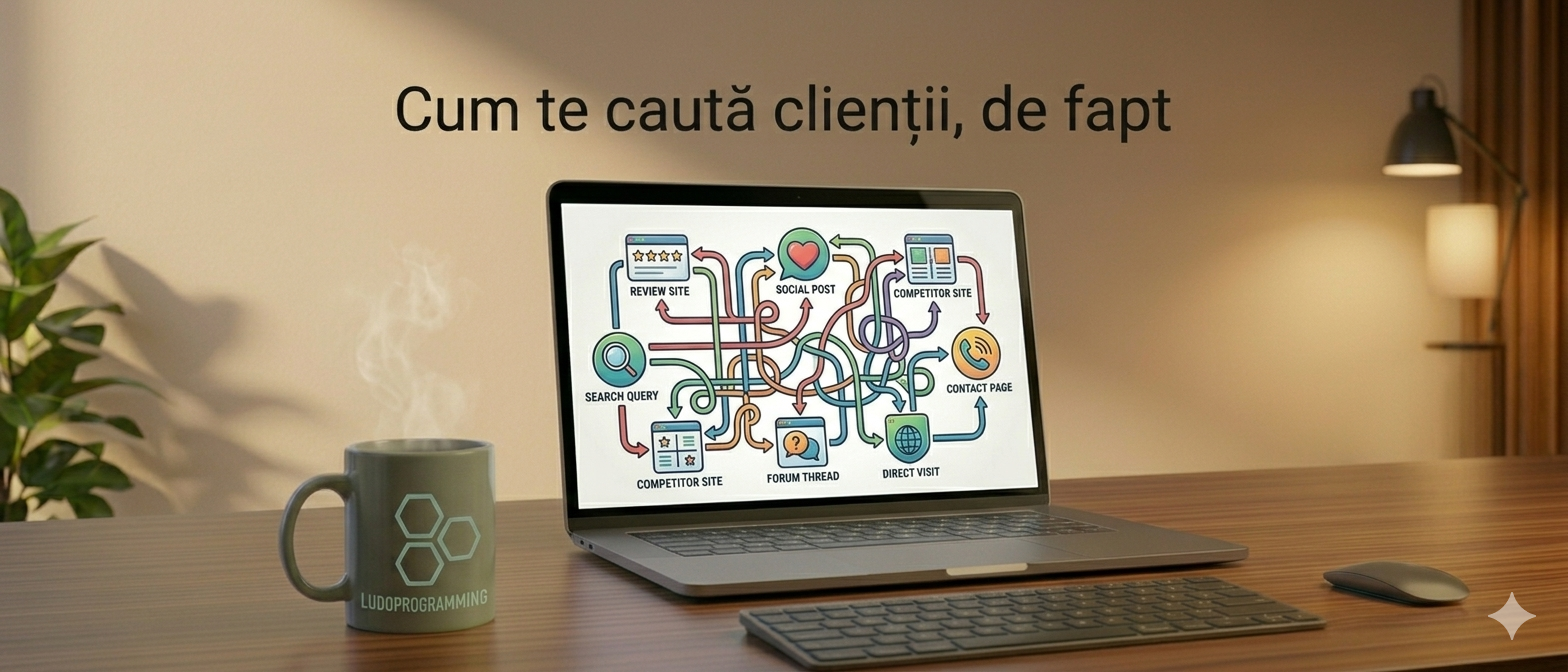
The reality is that the path a client takes from "I have a problem" to "I call this company" is much longer and more winding than it seems. Understanding this path can completely change the way you invest in promotion.
The myth of the client who "searches directly on Google"
The classic image is simple: the client has a need, opens Google, searches, finds your site, calls. Clean, linear, measurable.
This image is true for some clients — those with an urgent and well-defined need. If a pipe bursts, you look for an emergency plumber now. If the car won’t start, you look for a nearby auto service. The intention is clear, the decision is quick.
But for most services and products, the process is much longer. The client doesn’t know exactly what they are looking for or doesn’t know they need what you offer or compares several options before deciding.
What the client’s path actually looks like
Let’s take a concrete example: someone wants to renovate an apartment and is looking for a reliable builder.
They don’t search for "apartment renovation builder Bucharest" and call the first result. The real process looks more like this:
First, they look for inspiration — "3-room apartment renovation ideas" on Pinterest or Google Images. Then they start to understand the costs — "how much does apartment renovation cost 2026." Then they look for companies — "recommended renovation companies Craiova." They find a few, visit their websites, look at portfolios. They check reviews on Google and Facebook. Maybe they ask in Facebook groups or on forums. They request 2–3 quotes. Only then do they call or write.
Days or weeks can pass between the first thought and the first contact. And at every point along this path, you can be present or absent.
The three types of searches you need to know
Informational search — the client wants to understand something. "How does X work," "how much does Y cost," "what does Z mean." They are not ready to buy. They are in the education phase. If you have useful content that answers these questions — articles, guides, FAQs — you can appear in this phase and build authority.
Comparison search — the client knows what they want but hasn’t decided where from. "Best X companies in Cluj," "X vs Y differences," "reviews for company Z." They are in the evaluation phase. Reviews, portfolio, presence on directories and comparison platforms matter enormously here.
Transactional search — the client is ready to act. "Auto service Cluj schedule," "hairdresser Timisoara online booking." The intention is clear. If you are not visible in this phase, you lose a client ready to buy.
Most businesses are present only in the transactional phase. Those who win in the long term are present in all three.
The role of recommendations in the digital age
Recommendations haven’t disappeared — they have transformed. When someone receives a recommendation for a company, the first thing they do is search for it on Google. They want to see the website, reviews, portfolio, if it’s still active.
A verbal recommendation without a credible digital presence loses clients. The person searches for the company, finds nothing convincing, and chooses someone else from the first Google results who has 80 reviews and a clean website.
The recommendation worked — but the weak digital presence canceled it out.
Mobile vs. desktop search behavior
Over 60% of local searches are done from a phone. And mobile behavior is different from desktop:
On mobile, people search shorter and more directly — "pizza near me," "pharmacy open now." They want immediate answers. If your site doesn’t load in 3 seconds on mobile, they leave.
On mobile, direct call buttons from Google Maps or Google Search are used massively. A clear and clickable phone number can make the difference between a won client and a lost one.
On desktop, people compare more — open more tabs, read more, make slower decisions. Your site must convince also in the comparison scenario.
Voice searches and what they mean for you
Voice assistants — Google Assistant, Siri, Alexa — have also changed search behavior. People no longer type "Italian restaurant Cluj" — they say "Ok Google, where can I eat Italian in Cluj tonight?"
Voice searches are longer, more conversational, and almost always with local or immediate intent. If your Google Business Profile is complete and updated — hours, address, phone — you have good chances to appear in voice responses.
What all this means practically for you
There is no single channel through which clients find you. There is an ecosystem — Google Search, Google Maps, Facebook, recommendations, directories, reviews — and clients move through it non-linearly, at their own pace.
Some practical conclusions:
Be present at multiple points along the path, not just at the end. Informational content, reviews, visible portfolio, presence on Google Maps — all matter at different phases of the decision.
Assume that every new client will search for you on Google before contacting you. Even if they received a recommendation. Make sure what they find there convinces them.
Optimize for mobile without compromises. Your site must be fast, clear, and easy to use on the phone. Not "acceptable" — good.
Ask new clients how they found you. Don’t assume. Real data about your clients’ sources are the most valuable information you can have to decide where to invest in promotion.
Conclusion
Clients don’t search for you the way you think they do. They search for you at different moments, on different platforms, with different intentions — and their final decision is the sum of everything they found about you in that process.
The more present, consistent, and credible you are at multiple points along this path, the more clients will reach its end — to you.