
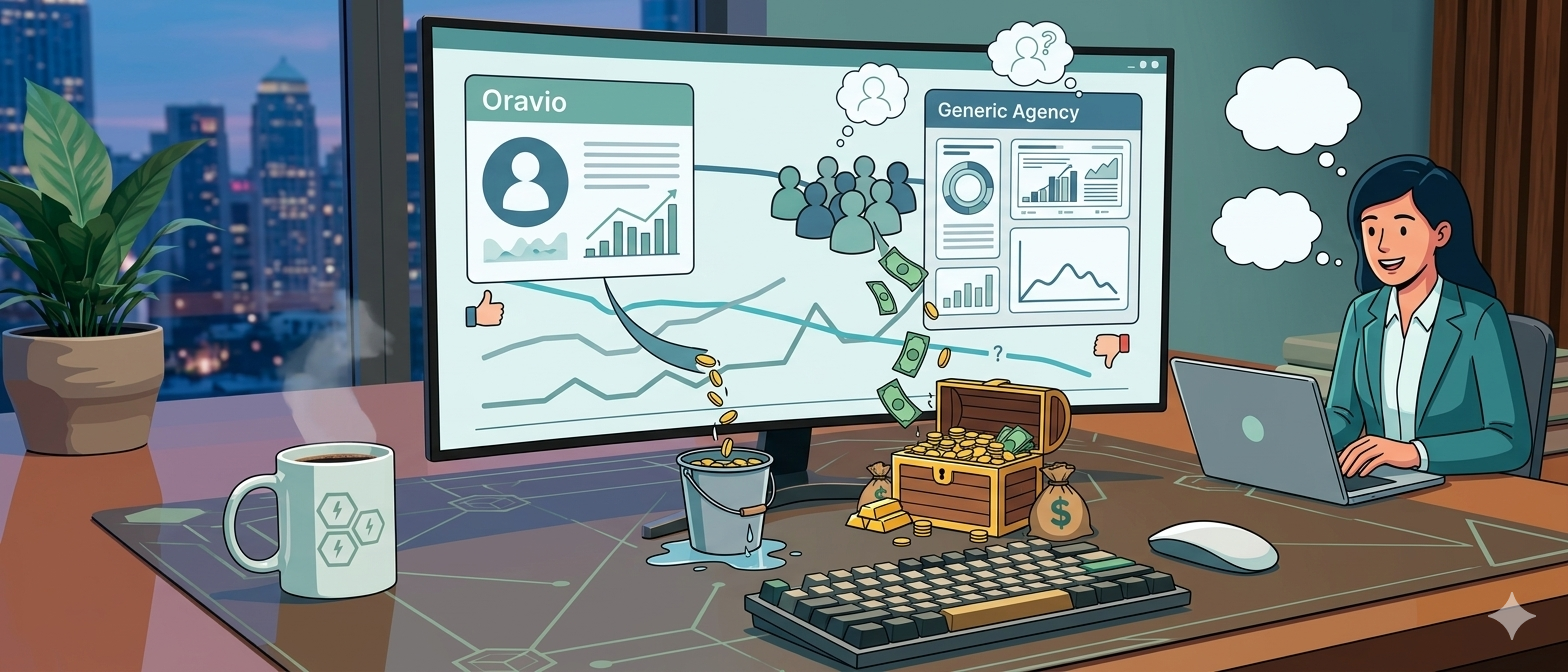
If you have ever searched for a marketing agency, you know what the landscape looks like: dozens of companies, all with impressive websites, all with similar promises, all "certified Google and Meta partners." How do you choose the right one without wasting money and time?
The answer is not complicated — but it requires knowing what to look for and what questions to ask. This article gives you exactly that.
Before you look for an agency — clarify what you want
The most common reason why collaborations with agencies fail is not the agency — it’s the lack of a clear objective from the client.
"I want to be more visible online" is not an objective. "I want to receive 20 online requests for quotes per month, compared to the 5 I have now" is an objective.
Before contacting any agency, answer these questions honestly:
— What concrete result do I want to achieve in 6 months?
— How much am I willing to invest monthly, including the advertising budget?
— Do I have a functional and fast website to send traffic to?
— Do I have time to provide feedback and approve content weekly?
Without clear answers to these, no agency can help you effectively — no matter how good it is.
What a good agency does — and what it doesn’t do
A good agency:
— Asks you questions before making an offer — about your business, your clients, what you have already tried
— Tells you clearly what it can and cannot do for you
— Presents a plan with measurable objectives, not just activities ("we will make 10 posts per month" is not an objective — it’s an activity)
— Gives you access to your accounts and data — Google Analytics, Meta Ads, Google Search Console
— Explains what it does and why, not just what it has done
A problematic agency:
— Makes you an offer within 24 hours without asking anything
— Promises guaranteed results ("first page on Google," "I will double sales in 3 months")
— Works on its own accounts, not yours — if you leave, you lose everything
— Sends you reports full of numbers without explaining what they mean for your business
— Avoids talking about concrete results and redirects to activities ("we increased reach by 40%")
Questions to ask before signing
Don’t hesitate to ask direct questions at the first meeting. A serious agency will appreciate them — a shady one will become defensive or evasive.
"Can you show me a concrete case from my industry?" — Not a general portfolio, but a client similar to you, with real and measurable results. If they don’t have experience in your field, it’s important to know that from the start.
"What indicators do we use to measure the success of the collaboration?" — The correct answer includes measurable things related to your business: leads, sales, calls, bookings. Not "reach," not "impressions," not "general engagement."
"Who actually works on my account?" — Many agencies sell with seniors and deliver with juniors or subcontracted freelancers. It’s not necessarily a problem, but you need to know who you’re really working with.
"Will the ads and social media accounts be in my name?" — The correct answer is yes, always. If the agency insists on working on its own accounts, it’s a major red flag.
"What happens if we are not satisfied after 3 months?" — A serious agency has a clear answer. One that avoids the question or pressures with long contracts without exit clauses deserves a much closer look.
Warning signs you should not ignore
Prices dramatically lower than the market. An agency offering SEO + social media + ads for 200 RON per month cannot deliver quality. Either they work with cheap and ineffective tools, outsource everything abroad without quality control, or simply do almost nothing.
Promises of quick results. SEO takes at least 4–6 months. Building an organic audience takes months. Anyone promising spectacular results in 30 days either uses risky techniques or is lying.
Lack of budget transparency. You need to know exactly how much of your money goes to the agency and how much actually goes into ads. A reasonable percentage for management is 15–30% of the ads budget. If they don’t want to specify, it’s a problem.
Contracts with abusive clauses. Minimum periods of 12 months without exit clauses, large penalties for early termination, intellectual property rights over content created for you — all are signs that the agency protects itself, not you.
They don’t give you access to data. If you can’t see Google Analytics, Meta Ads Manager, or Google Search Console yourself — or if they only send you selected screenshots — you have no way to independently verify what’s happening with your money.
Freelancer vs. agency — which is better for you
It’s not necessarily that one is better than the other — it depends on what you need.
A freelancer is preferable if you need one thing done well — only SEO, only social media, only ads. It costs less, you work directly with the person doing the work, communication is simpler.
An agency is preferable if you need multiple integrated services — strategy, content, ads, SEO — and want a single point of contact coordinating everything. It costs more but has resources that a single freelancer cannot cover.
A good freelancer beats a mediocre agency anytime. The criterion is not the format — it’s quality and fit with your needs.
How to check an agency’s reputation before signing
— Look for reviews on Google Maps and Facebook — not just what’s on their website
— Ask for references and actually contact 1–2 existing clients
— Search the company on ANAF and the Trade Register — is it registered, does it have history, does it have real turnover?
— Check if their own website is well made and if they themselves appear on Google for the services they offer — an SEO agency that doesn’t appear on Google for "SEO agency [city]" says something about them
Conclusion
A good marketing agency is a partner, not a supplier. It works with you, not for you — and that means you are also involved, have clear objectives, and monitor results.
The best way not to be fooled is to know what you want, ask the right questions, and not rush to sign. A bad collaboration costs not only the money in the contract — it also costs lost time and missed opportunities.
Healthy skepticism is not hostility towards agencies — it’s respect for your own investment.