
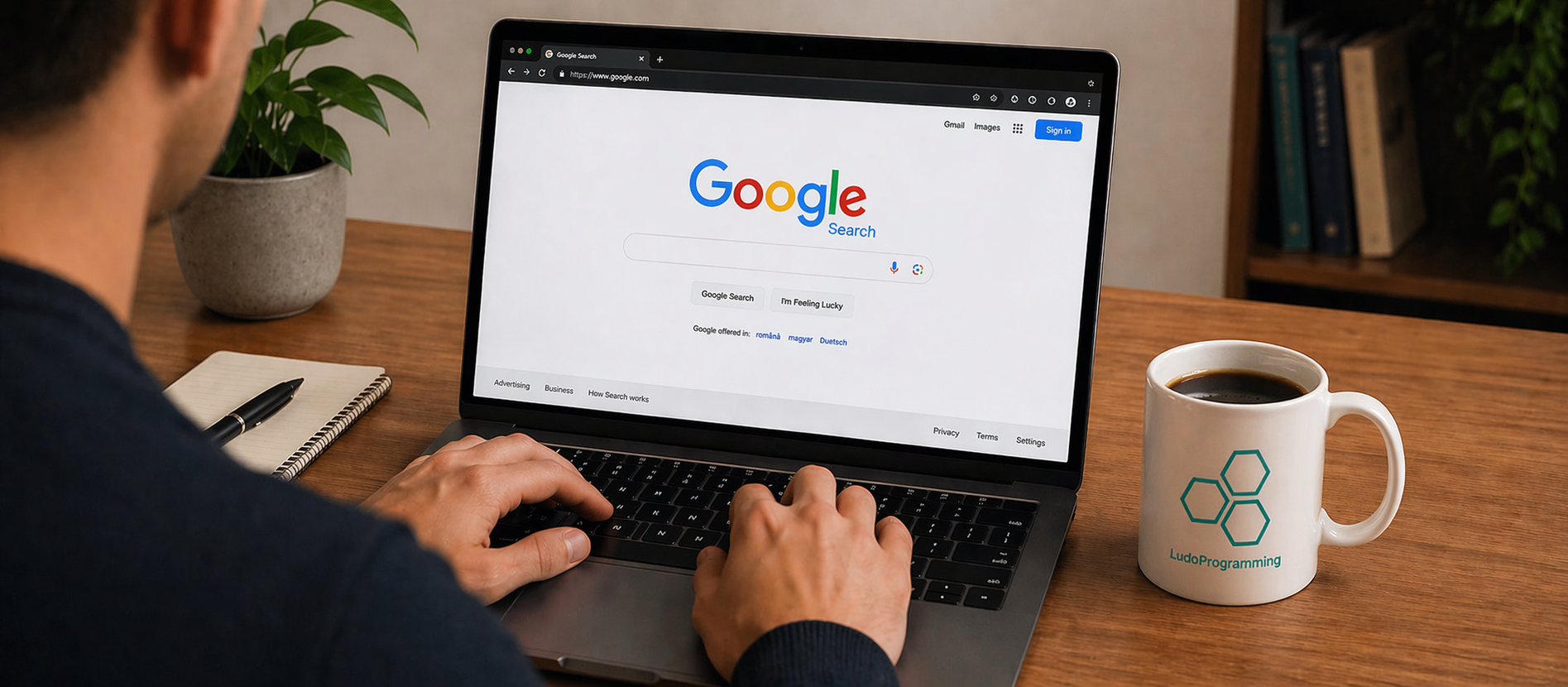
If you have a website and someone has ever told you that "you need SEO" without explaining what it means, you are not alone. SEO is one of the most used and most misunderstood concepts in digital marketing.
Some present it as a secret science. Others as a miraculous solution. In reality, it is neither.
What SEO means, in plain language
SEO stands for Search Engine Optimization — optimization for search engines. In practice, it means a set of actions through which you make your website easier to understand and recommend by Google.
When someone searches on Google "car service Cluj" or "divorce lawyer Bucharest," Google decides in a fraction of a second which websites to display and in what order. SEO is everything you do to make your site appear as high as possible on that list — without paying for the position.
This is the fundamental difference compared to paid ads: organic traffic from SEO does not cost per click. Once obtained, it comes continuously, without paying each time.
How Google decides who appears first
Google has one goal: to offer the user the most relevant and useful result for their search. Everything the Google algorithm does aims at this goal.
When evaluating a site, Google looks at hundreds of factors. But the most important are grouped into three categories:
Relevance — does your website content answer what the person is searching for? If someone searches "how to plant tomatoes" and your page talks exactly about that, you are relevant. If your page is about gardening in general, you are less relevant.
Authority — do other trusted websites link to you? A link from a respected site is like a recommendation — Google interprets it as a vote of confidence. The more such recommendations you have, the more you are considered authoritative in your field.
User experience — does your site load quickly? Is it easy to use on a phone? Do people stay on it or leave immediately? Google monitors all these and includes them in the calculation.
What SEO is NOT
As important as knowing what SEO is, is knowing what it is not, so you don’t fall into costly traps.
SEO is not an immediate result. Unlike paid ads that work from day one, SEO is a long-term process. Results are generally seen after 3–6 months, sometimes more. Anyone who promises to get you on the first Google page in two weeks is either lying or using techniques that will harm you in the long run.
SEO is not a one-time thing. Google constantly updates its algorithm. Your competition is also working on SEO. If you stop, the positions you gained will gradually erode.
SEO does not mean stuffing keywords everywhere. The practice of obsessively repeating "car service Cluj car service Cluj car service Cluj" in the text has not worked since 2012. On the contrary, Google penalizes content that seems written for the algorithm, not for people.
SEO is not the same as Google Ads. Google Ads are the results marked with "Ad" that appear at the top. SEO refers to the organic, unmarked results below. Both have value, but they are different tools.
The three types of SEO
On-Page SEO — everything you do on your site: page titles, text structure, image descriptions, loading speed, mobile version. These are under your direct control and are the first place to start.
Off-Page SEO — everything that happens outside your site: links from other sites, mentions in the press, reviews on Google Maps, presence in local directories. You build your site's reputation in Google's eyes.
Technical SEO — the deeper aspects of the site: URL structure, server speed, SSL certificate, sitemap, crawling errors. Usually, this is the domain of a specialist, but serious technical problems can nullify everything you do in the other two categories.
Where to start if you are a small business
You don’t have to do everything at once. There are a few steps with high impact and reasonable effort:
Google Business Profile — if you haven’t set it up, do it today. It’s free and the fastest way to appear on Google Maps and in local results. Many small businesses gain customers almost exclusively from here.
Clear pages for each service — if you offer 5 services, you need 5 separate pages, each dedicated to a single service. One single "Services" page listing them all is much harder to rank on Google.
Content that answers real questions — what do your customers ask most often? Write articles or pages that answer those questions. Don’t write for Google — write for the people who could become your customers.
Speed and mobile version — over 60% of Google searches come from phones. A slow or hard-to-use mobile site loses both visitors and Google rankings.
How long it takes and how much it costs
Well-done SEO is a long-term investment with increasing returns. The cost varies greatly depending on the competition in the field, the current state of the site, and who does the work.
A local business with medium competition can see relevant results in 4–6 months with consistent effort. A very competitive field — law, real estate, medical clinics — may require 12–18 months and a significant monthly budget.
If you do SEO yourself, the main cost is time. If you work with a specialist, prices in Romania start from 500–800 RON/month for basic services and can reach several thousand lei for complex projects.
Conclusion
SEO is not magic and not a mystery. It is the systematic process of making your site more relevant, more trustworthy, and easier to use — both for Google and for the people who visit it.
It does not bring overnight results, but the results it brings are among the most durable in digital marketing. A well-written article today can bring visitors for years, without any additional cost.
If you have a website and haven’t started thinking about SEO, the best time was a year ago. The second best time is now.