
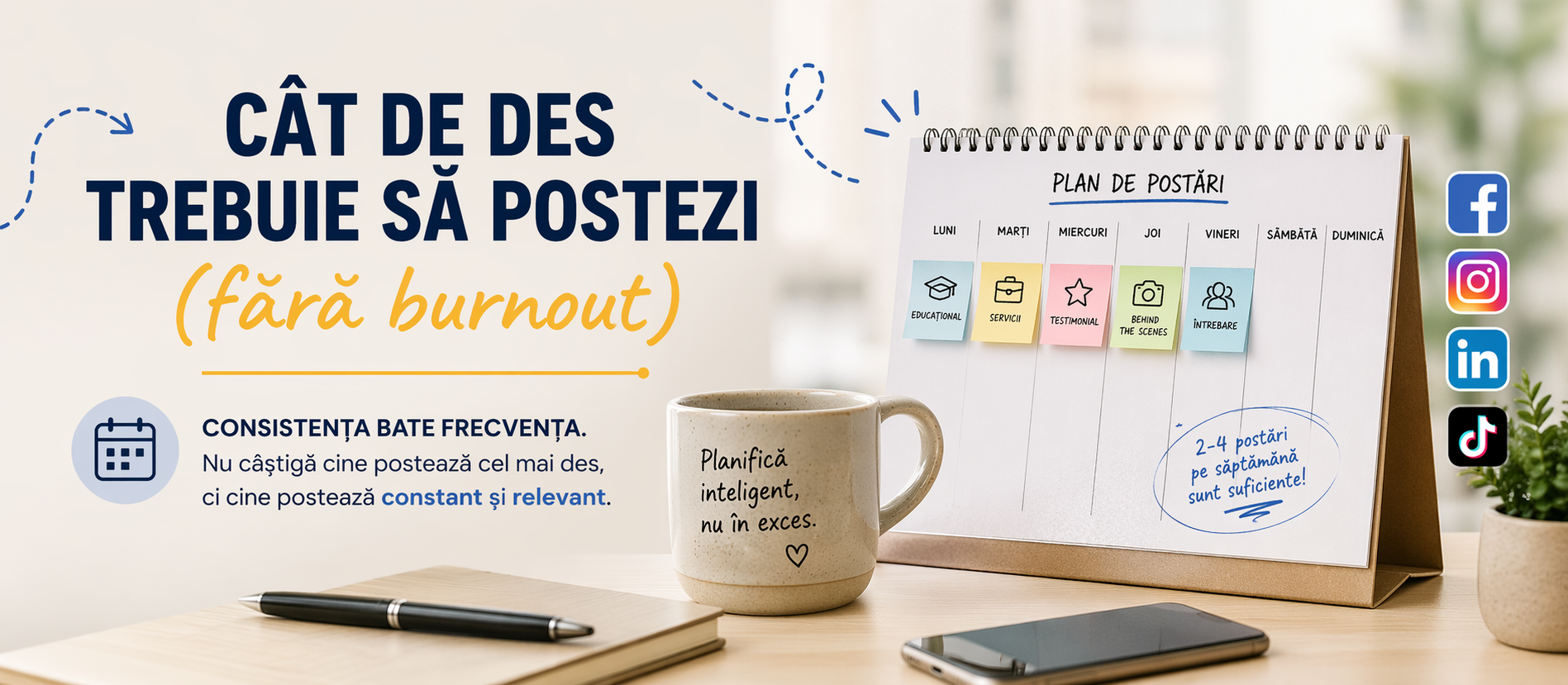
If you have ever searched for „how often to post on Instagram” or „optimal Facebook frequency”, you have probably come across answers like: 3 times a day on TikTok, 5 times a week on Instagram, daily on Facebook.
And then you closed the browser and didn’t post anything for a week. That’s exactly what advice disconnected from reality causes.
The truth is different: the optimal frequency is the one you can maintain consistently, in the long term. Not the one recommended by an American guru with a team of 10 people.
Why consistency beats frequency
Social media algorithms don’t reward volume — they reward consistency and engagement. A page that posts twice a week, consistently, for 6 months, will perform better than one that posts daily for 3 weeks and then disappears.
The reason is simple: the algorithm learns when your followers are active and when you post. If you are unpredictable, the distribution of your content becomes unpredictable.
More importantly: your followers get used to you. If you regularly appear in their feed — even twice a week — you become a familiar name. Familiarity builds trust. Trust brings clients.
Realistic frequencies, by platform
Here’s what works for a small business without a dedicated marketing team:
Facebook: 3–5 posts per week. Facebook penalizes overposting — quality and reactions matter more than volume.
Instagram: 3–4 posts per week in the feed + 2–3 Stories daily. Stories are easier to make and maintain visibility between posts.
TikTok: ideally daily, but if you don’t have the resources, 3–4 videos per week are enough to grow organically. TikTok is the only platform where volume really matters significantly.
LinkedIn: 2–3 posts per week are more than enough. LinkedIn rewards posts with substance, not quantity.
Signs you are posting too much (or too little)
You post too much if: your content is repetitive, engagement has dropped compared to 2 months ago, or you feel exhausted and resentful about posting activity. Followers sense when content is forced.
You post too little if: more than 10 days pass without any post, if people no longer recognize your page when it appears in their feed, or if you haven’t posted anything in the last month. Below a certain minimum frequency, the algorithm practically „forgets” you.
The batch trick: post once a week, appear daily
The most practical system for a small business: a content creation session once a week, lasting 1–2 hours, in which you prepare all the content for the following week.
You photograph 3–4 images, write the texts, schedule the posts through Meta Business Suite (free) or Buffer (cheap). Monday morning you are „ready” for the whole week.
The major advantage: you no longer post reactively, hurriedly, with texts written in 2 minutes. Everything is thought out, checked, and scheduled. Quality increases, stress decreases.
Evergreen content vs timely content
Not all content has the same urgency. Evergreen content — useful tips, service presentations, testimonials, answers to frequently asked questions — can be created in advance and scheduled anytime.
Timely content — a weekend discount, industry news, a situation from the workshop or office — is created on the spot but doesn’t have to be perfect. A Story filmed with a phone, authentic, often works better than elaborate graphics.
The recipe that works: 80% planned content + 20% spontaneous content. Structure gives you breathing room, spontaneity gives you authenticity.
When to reduce frequency, not abandon
If you feel you can’t keep up the pace, the answer is not to disappear completely. Reduce, don’t abandon.
Go from 5 posts a week to 2. Or post only Stories for a while. Or make one big post a week instead of 4 small ones. Anything is better than complete silence for 3 weeks.
Followers forgive a quieter period. They don’t forgive total absence followed by spam when you „come back motivated”.
Conclusion: find your rhythm, not someone else’s
There is no universal frequency. There is the frequency that you can sustain consistently, without exhausting yourself, without sacrificing quality, and without hating the idea of opening the social media app.
Start with less than you think you can do. Maintain it for 30 days. If it goes well, add one post per week. You build a system, not a sprint.
The best content calendar isn’t the one with the most boxes checked — it’s the one you stick to next month, and the month after.