
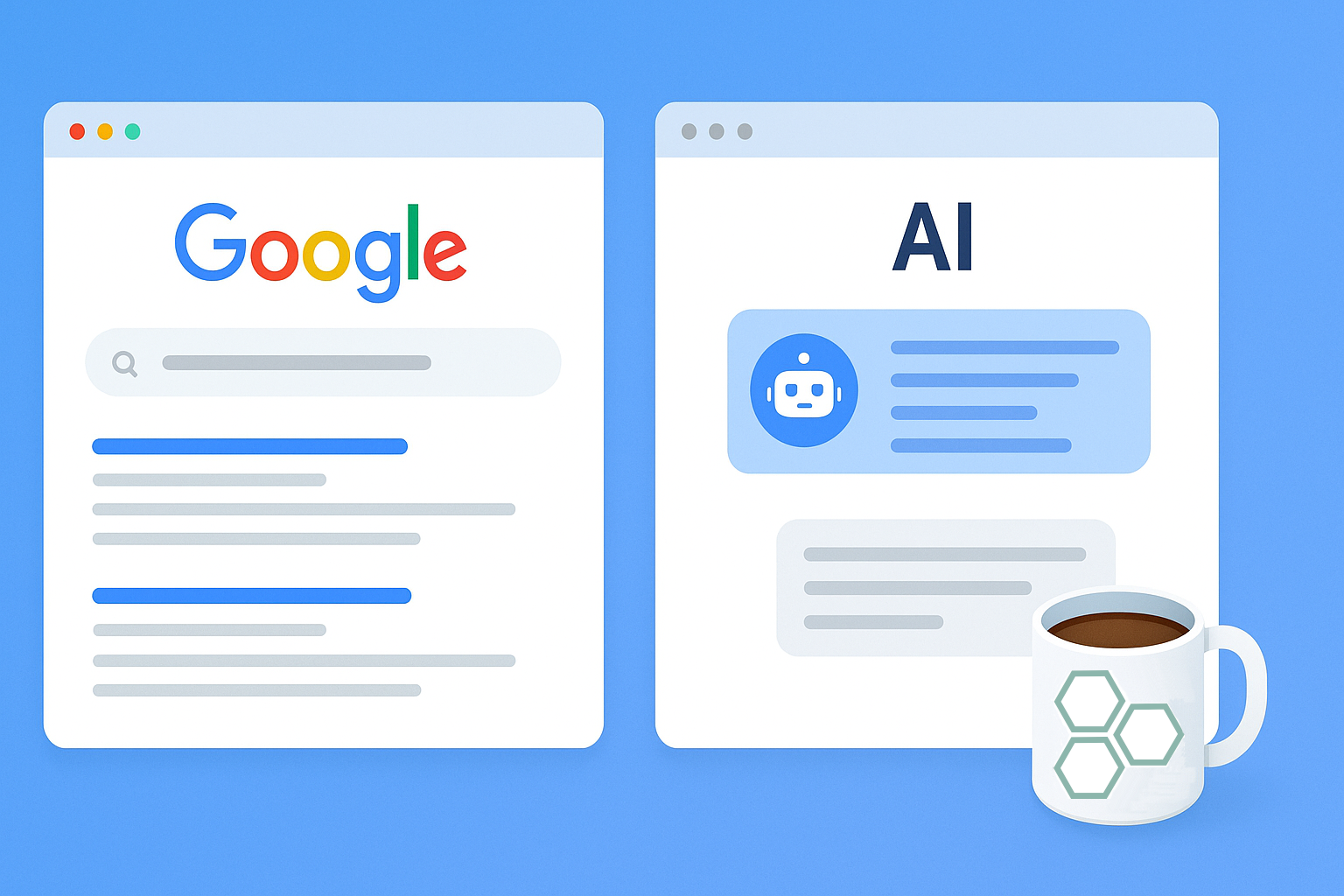
In recent years, the way we search for information on the internet has changed dramatically. While Google used to be the "gateway" for any question, today more and more users turn directly to conversational AI – such as ChatGPT, Gemini, Claude, or Perplexity – to get quick and concise answers.
But what does this mean for websites, organic traffic, and SEO?
How AI changes the way we search
AI engines do not just display a list of links. They:
-
understand the context of the question and provide a direct answer;
-
aggregate information from multiple sources and rewrite it in an easy-to-read form;
-
respond conversationally, allowing additional questions for clarification.
Example:
-
Google → "best web frameworks 2025" → list of links with blogs and reviews.
-
ChatGPT or Gemini → directly gives you a summarized top list, with the advantages of each framework.
The result? The user may not visit any site – they receive the answer already "served".
Why classic organic traffic is decreasing
This change has a direct impact on traffic:
-
Fewer users click on links from Google.
-
AI takes over the information, and websites no longer receive visits for the same questions.
-
The phenomenon of "zero-click search" expands to a conversational level – not just through Google snippets, but through complete AI answers.
Consequence:
Even well-optimized sites for classic SEO may notice a drop in visits, as answers are consumed directly in the AI interface.
Comparative examples Google vs AI
🔎 Google:
-
It offers you 10 organic results + ads.
-
You have to visit multiple sites to find a complete answer.
-
Classic SEO matters enormously for visibility.
🤖 AI (ChatGPT, Gemini, Claude, Perplexity):
-
It gives you the direct, summarized answer.
-
It integrates diverse sources into a single explanation.
-
In some cases, it mentions sources (Perplexity), but the user no longer necessarily has the motivation to visit the site.
Conclusion
Internet searching no longer looks like it did 5 or 10 years ago.
AI completely changes the dynamic: from a "list of options" (Google) → to a final and conversational answer.
For businesses and content creators, this means a huge challenge: how to remain relevant and visible in a world where users no longer click on links?
This is the first step in a series of articles about SEO in the AI era. In the next one, we will discuss why SEO is not dying but transforming.